
Every year, local councils in England deal with over a million fly-tipping incidents — and a worrying proportion of them involve asbestos. Broken cement sheets dumped in a lay-by, garage roof panels thrown into a ditch, bags of unknown building waste left on farmland: these are scenes our teams are called to across Staffordshire, Cheshire and the wider region on a regular basis.
Fly-tipped asbestos is different from most dumped waste. It isn't just unsightly — it's a genuine health hazard, a pollution risk, and something that only HSE-licensed professionals should ever handle. This guide covers everything you need to know if you've found suspected asbestos dumped near your home, on your land, or in your community.
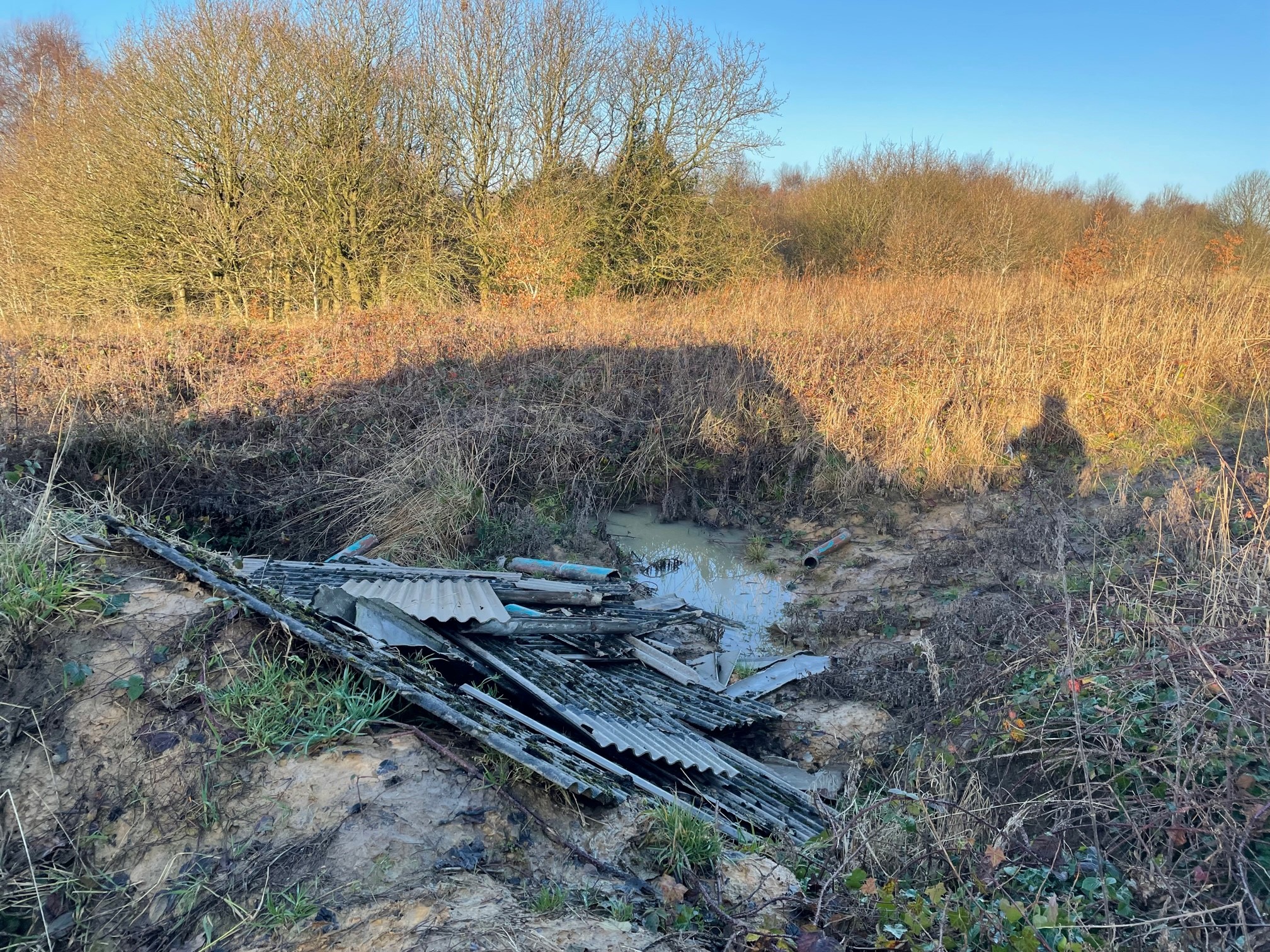
Fly-tipped asbestos cement sheeting attended by the AIB Solutions team.
What Counts as Fly-Tipped Asbestos?
Fly-tipping is the illegal dumping of waste on land that doesn't have a licence to accept it — roadsides, ditches, fields, alleyways, car parks and private land. When that waste contains asbestos, it becomes classified as hazardous waste, and everything about how it must be handled changes.
The most commonly fly-tipped asbestos materials we encounter include:
- Asbestos cement sheets — corrugated garage and shed roofing, the single most common fly-tipped asbestos material in the UK
- Asbestos cement flat sheets and panels — from garage walls, soffits, and outbuildings
- Asbestos cement pipes, flues and gutters — often mixed in with general building rubble
- Floor tiles and bitumen adhesive — bagged or loose, frequently dumped after DIY renovations
- Asbestos insulating board (AIB) — a higher-risk material sometimes found in dumped ceiling panels, partition boards and fire door cores
- Textured coatings (Artex) — broken plasterboard with textured finishes from pre-2000 properties
Asbestos was used in thousands of building products until it was fully banned in the UK in 1999. Any building material dumped from a property built or refurbished before 2000 could potentially contain it — which is exactly why dumped building waste should never be handled casually.
Why Fly-Tipped Asbestos Is So Dangerous
Asbestos in good condition, left undisturbed, releases very few fibres. Fly-tipped asbestos is the opposite scenario in almost every way.
It's usually already damaged
Material that has been ripped off a roof, thrown into a van, and tipped out onto the ground is almost always broken, cracked or crumbling. Damaged asbestos cement releases fibres far more readily than intact sheets, and every fresh break exposes new fibre-bearing edges.
It's in a public, uncontrolled environment
Unlike asbestos inside a building, dumped material can be disturbed by anyone — children playing, dog walkers, passing vehicles, or well-meaning members of the public trying to "tidy it up". There is no enclosure, no signage and no control over who comes into contact with it.
Weathering makes it worse over time
Rain, frost and sun steadily degrade the cement matrix that binds asbestos fibres in place. The longer fly-tipped asbestos sits outside, the more friable and hazardous it becomes. A dumped sheet that was relatively stable in January can be shedding fibres by summer.
It contaminates land and watercourses
Asbestos dumped in ditches, streams or on soft ground can fragment and spread. Small pieces work into the soil, and once land is contaminated with asbestos debris, the clean-up becomes significantly more involved — sometimes requiring the removal of contaminated topsoil as well as the visible waste.
There is no known safe level of asbestos exposure. Inhaled fibres can cause mesothelioma, asbestos-related lung cancer and asbestosis, often decades after exposure. Asbestos-related disease remains the biggest cause of work-related deaths in the UK, which is why the law treats this material so seriously.
How to Recognise Asbestos in Dumped Waste
You can't confirm asbestos by eye — laboratory analysis is the only definitive method. But there are strong visual indicators that dumped waste deserves extreme caution:
- Corrugated grey cement sheets — the classic "wriggly tin"-style profile, often with moss or lichen growth, typical of old garage and barn roofs
- Dimpled or golf-ball surface texture on flat grey boards, common with asbestos cement and AIB
- Grey-white fibrous edges where sheets have snapped, sometimes with visible fibre bundles
- Old brittle floor tiles, typically 9-inch squares in dark red-brown, green or marbled patterns, often with black bitumen adhesive on the back
- Broken plasterboard with swirled or stippled textured coatings
- Waste in red or clear "asbestos" printed sacks — a sign someone started a compliant disposal process and then abandoned it illegally
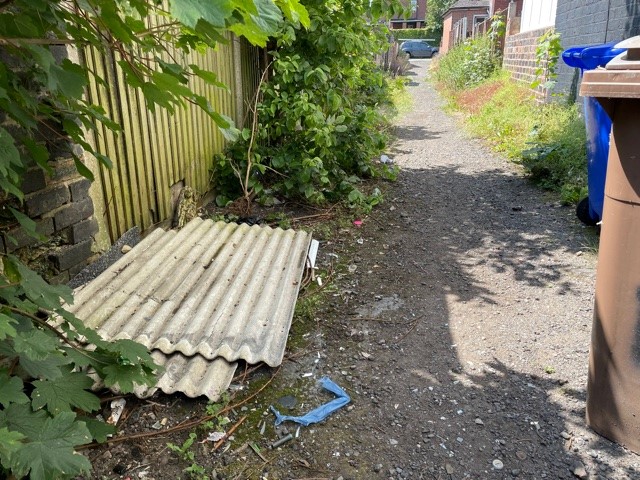
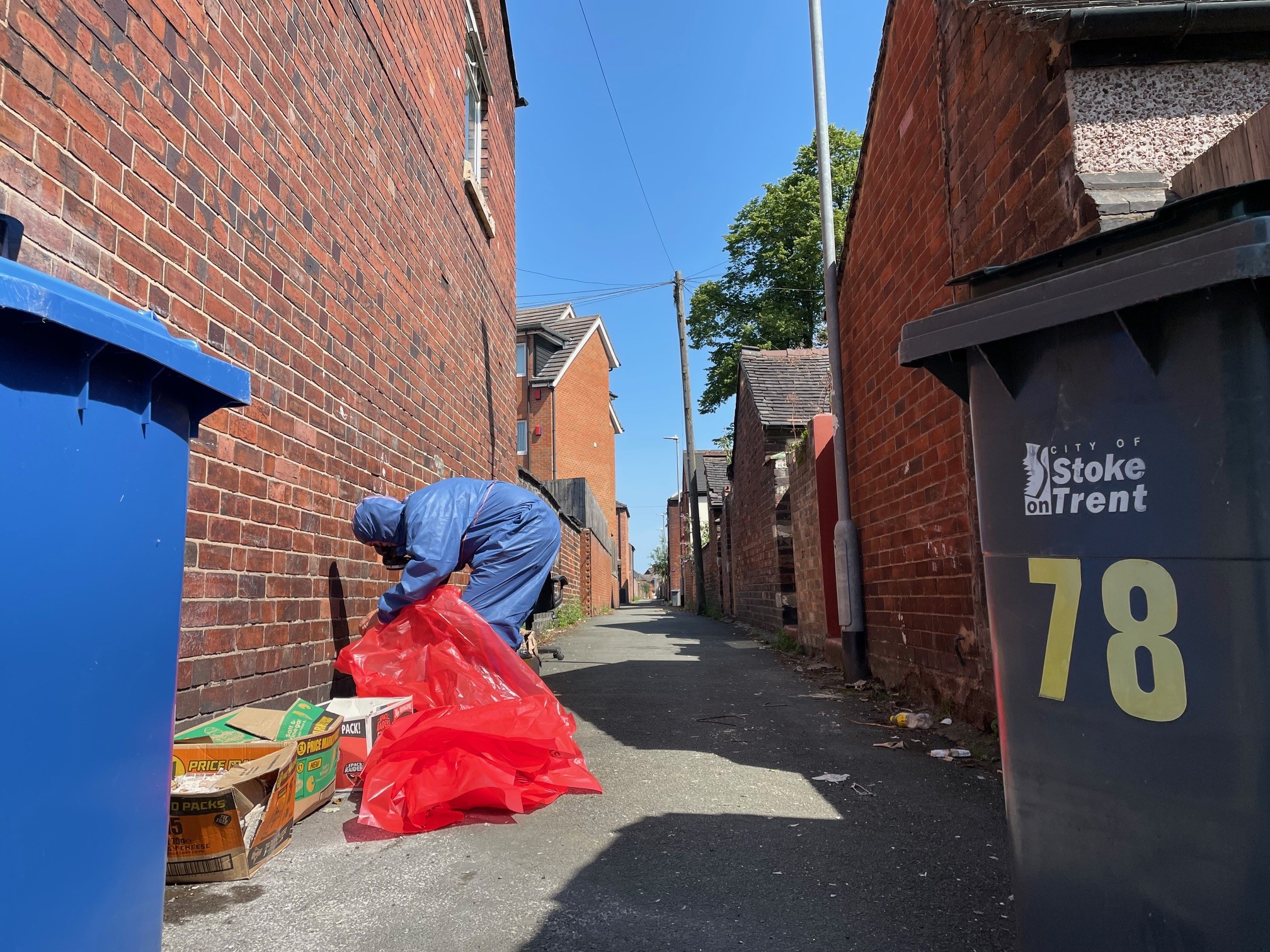
Broken, weathered asbestos cement is far more likely to release fibres than intact material.
What to Do If You Find Fly-Tipped Asbestos
Whether it's on a public verge or your own driveway, the immediate steps are the same:
- Don't touch or move it. Moving damaged asbestos is the most likely moment for fibre release. Never attempt to stack, bag or break up suspect material.
- Keep people and pets away. If it's on your land, cordon the area off if you can do so without handling the waste. Keep children and animals well clear.
- Don't sweep up fragments. Dry sweeping or using a domestic vacuum on asbestos debris can spread fibres into the air — it's one of the worst things you can do.
- Photograph it from a safe distance. Photos help with reporting, identification and — if it's on your land — any insurance claim.
- Report it. On public land, report to your local council (most have an online fly-tipping form) or via gov.uk. Larger incidents, or dumping in watercourses, should also be reported to the Environment Agency on 0800 80 70 60.
- Call a licensed asbestos removal contractor if the waste is on land you own or manage. Suspected asbestos should only ever be handled by trained, licensed professionals.
Who Is Responsible for Removing Fly-Tipped Asbestos?
This is the question we're asked most often — and the answer depends entirely on where the waste has been dumped.
On public land
If asbestos is dumped on public highways, verges, parks or council-owned land, the local authority is responsible for arranging its removal. Report it and let the council's contractors deal with it. You should never attempt to clear it yourself, even "to help".
On private land
Here's the part that surprises many people: if waste is fly-tipped on private land, the landowner is legally responsible for its removal and disposal — even though they are the victim of the crime. Councils are not obliged to clear private land, and failing to deal with dumped asbestos can itself lead to enforcement action if it poses a risk to others.
For farmers, landlords, commercial premises and homeowners with accessible driveways or gateways, this means fly-tipped asbestos becomes your problem to resolve — safely, legally and with full documentation. This is exactly the situation where using an HSE-licensed contractor protects you: you get a compliant removal, hazardous waste consignment notes proving legal disposal, and a clear paper trail should the Environment Agency or your insurer ever ask.
The Law: Fly-Tipping Asbestos Is a Serious Criminal Offence
Fly-tipping any waste is illegal under the Environmental Protection Act 1990. When the waste is asbestos, several layers of law apply at once:
- Unlimited fines and up to five years' imprisonment for fly-tipping offences dealt with in the Crown Court, plus vehicle seizure and clean-up cost recovery
- Hazardous waste regulations — asbestos must be consigned, transported and disposed of at a licensed facility with full documentation; dumping it breaches these duties outright
- The Control of Asbestos Regulations 2012 (CAR 2012) — which govern how asbestos is handled, and which any legitimate contractor must work to
- Duty of care — householders and businesses have a legal duty to check that anyone taking waste away is a licensed waste carrier. If your builder or "man with a van" fly-tips your asbestos, you can be prosecuted too
That last point matters. Much of the fly-tipped asbestos we remove was originally handed over in good faith to unlicensed operators offering cheap waste clearance. Always ask to see a waste carrier licence — you can verify any carrier free of charge on the Environment Agency's public register.
How AIB Solutions Removes Fly-Tipped Asbestos Safely
We've been removing asbestos as an HSE-licensed contractor since 2005, and fly-tipped material is a regular part of our workload — from single dumped sheets behind a garage to large mixed loads tipped across farmland and ditches. Every job follows the same controlled process under CAR 2012:
- Site assessment. We inspect the location, the condition of the material and the surrounding risks — access, ground conditions, proximity to the public and watercourses — and agree the safest removal method.
- Identification and testing where needed. If there's any doubt about what's been dumped, we collect samples on site and send them to a UKAS-accredited laboratory for analysis before work begins.
- Controlled removal. Trained operatives in full PPE and RPE remove the material using HSE-approved techniques, damping down to suppress fibres and hand-picking fragments where the waste has broken up.
- Environmental clean-up. Where material has fragmented into soil, ditches or vegetation, we clear contaminated debris so the area is left genuinely safe — not just visibly tidy.
- Licensed disposal. All asbestos waste is double-bagged or wrapped, sealed, labelled and transported under hazardous waste consignment to a licensed disposal facility.
- Full documentation. You receive waste consignment notes and a record of the works — your legal proof of compliant disposal.
Because we hold our own HSE asbestos removal licence and operate as an EA-licensed waste carrier, the entire job — assessment, removal, transport and disposal — is handled by one accountable team.
What Does Fly-Tipped Asbestos Removal Cost?
Costs depend on the amount of material, its condition, how far it has spread, and site access. A few dumped cement sheets on hardstanding is a very different job to fragmented AIB scattered through a ditch. As a guide:
- Small, intact loads (a few sheets, easily accessible) are typically quick, fixed-price jobs
- Broken or scattered material costs more because of the hand-picking and clean-up involved
- Contaminated ground may require debris clearance or soil removal, which we'll assess and price up front
We provide free, no-obligation fixed quotes — often from photos for straightforward jobs — so you know exactly where you stand before any work begins. What we'd always caution against is the cheapest possible quote from an unlicensed operator: if your waste is fly-tipped again elsewhere, the trail can lead back to you.
Preventing Asbestos Fly-Tipping on Your Land
For landowners who have been targeted once, repeat dumping is a real risk. Practical steps that help:
- Secure gateways and field entrances with locked gates, bunds or boulders
- Improve lighting and consider CCTV or trail cameras at known hotspots
- Remove dumped waste promptly — accumulating waste attracts more waste
- Report every incident, even small ones, so councils can build a pattern of evidence
- If you're disposing of your own asbestos, use a licensed contractor and keep the paperwork — never a cash-in-hand clearance
Fly-Tipped Asbestos: Frequently Asked Questions
Is it safe to walk past fly-tipped asbestos?
Can I move fly-tipped asbestos off my driveway myself?
Will the council remove asbestos dumped on my private land?
How do I know if the dumped material actually contains asbestos?
Who pays for fly-tipped asbestos removal?
Is asbestos cement as dangerous as other asbestos?
How quickly can AIB Solutions attend a fly-tipping incident?
Found Fly-Tipped Asbestos? We Can Help
AIB Solutions has held an HSE asbestos removal licence since 2005 and is trusted across Staffordshire, Cheshire, Shropshire and the West Midlands for safe, fully documented asbestos removal — including fly-tipped and abandoned asbestos waste of every kind. Whether it's a single dumped sheet or a large contaminated site, our team will assess it, remove it and dispose of it legally, leaving the area safe and your paperwork in order.
📞 01782 613773
📧 info@aibsolutions.co.uk
🌐 Domestic Asbestos Services · Commercial Asbestos Removal