
 Guide · Choosing a contractor
How to choose an asbestos removal company. 10 checks before you hire.
The qualifications, licences and paperwork a UK asbestos removal contractor should have, what to ask before you hire, and the red flags to walk away from.

To be properly qualified, a UK asbestos removal company should hold an HSE asbestos licence for licensed work, train its team to the Control of Asbestos Regulations 2012 with annual refreshers, notify the HSE before licensed work starts, use independent clearance after removal, dispose of waste through a registered waste carrier with a consignment note, and give you a fixed written quote. Trade body membership, such as ARCA, is a strong extra sign of quality.
Asbestos is the one job you can't re-do.
If a kitchen fitter gets it wrong, you can rip it out and start again. If asbestos is removed badly, fibres can be spread through a building, and that can't be undone.
That's why asbestos removal is one of the most tightly regulated trades in the UK. The good news is that the rules give you a clear set of things to check. If a contractor can show you all ten of the points below, you're in safe hands.
10 checks before you hire anyone.
An HSE asbestos licence, for licensed work
The most hazardous asbestos work, including most asbestos insulating board (AIB), pipe lagging and sprayed coatings, can only legally be carried out by a contractor holding a licence from the Health and Safety Executive (HSE). Licences are reviewed and renewed, so a contractor's licence should be current, not just something they held once.
Honest advice on licensed vs non-licensed work
Not every asbestos job needs a licensed contractor. Asbestos cement garage roofs and textured coatings are usually non-licensed work, while AIB and lagging usually are. A good contractor tells you which category your job falls into and why. Be wary of anyone who inflates a simple job, or plays down a licensed one to make it cheaper.
A properly trained team
Under the Control of Asbestos Regulations 2012 (CAR 2012), everyone who works with asbestos must be trained for the work they do, with refresher training every year. Membership of a trade body such as ARCA (the Asbestos Removal Contractors Association) shows a contractor's training is checked independently.
Medicals and face-fit tested masks
Operatives on licensed work must have regular medical surveillance, and anyone wearing a tight-fitting mask must be face-fit tested for it. These are basic legal requirements, so a reputable contractor will be happy to confirm them.
HSE notification and a written plan of work
Licensed work must normally be notified to the HSE at least 14 days before it starts, and every job needs a written plan of work describing how the asbestos will be removed safely. If a contractor offers to start licensed work tomorrow without either of these, that's a warning sign.
The right controls on site
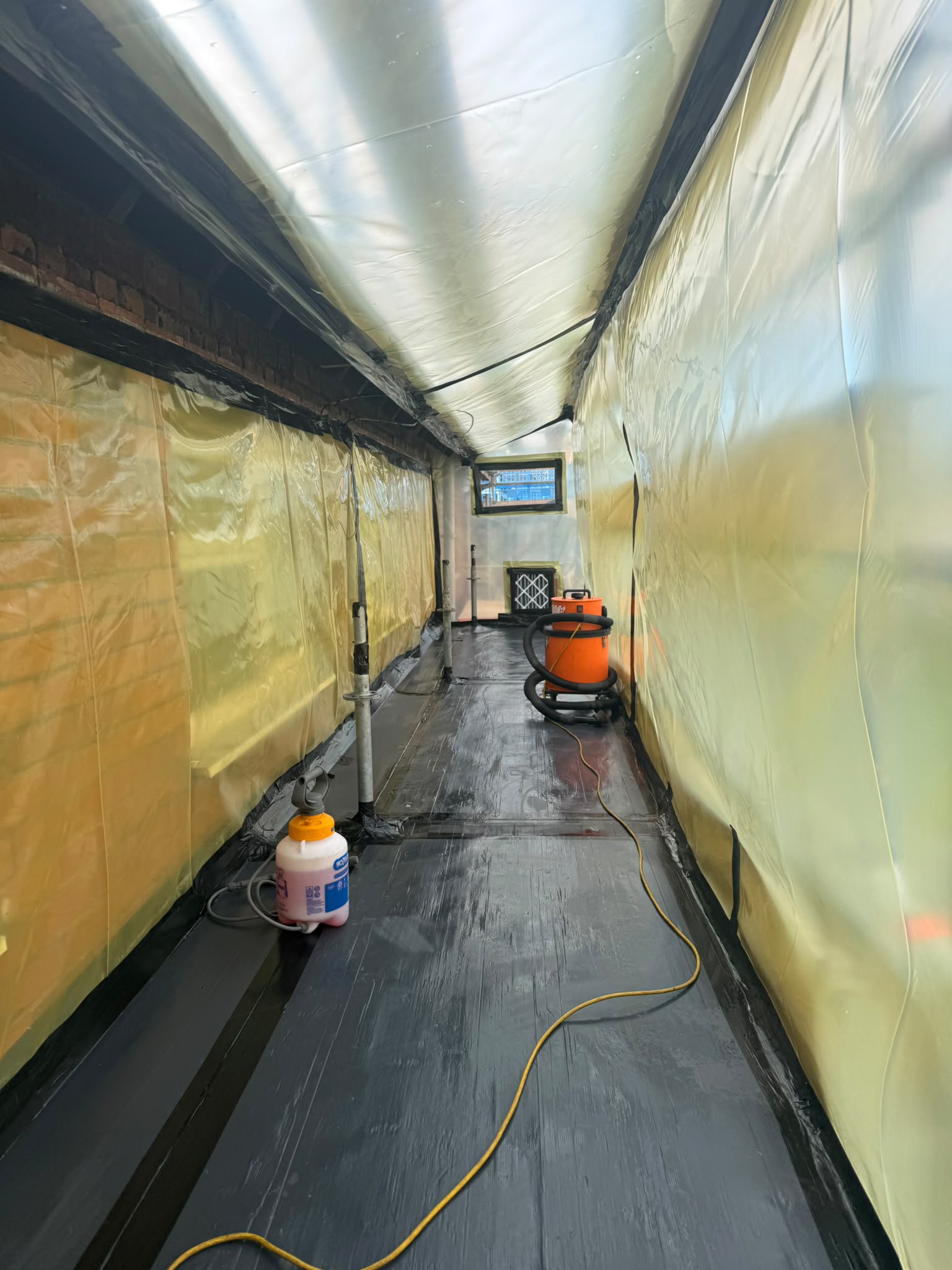
Licensed removal is carried out inside a sealed enclosure, kept under negative pressure, with a decontamination unit so nothing leaves on clothing or boots. The set-up is how fibres are kept where they belong, so you should be able to see it.
Independent clearance before handover
After licensed removal, the area should be checked by an independent analyst, not the contractor, through a four-stage clearance before it's handed back. This independent sign-off is your proof that the area is safe to use again.
Legal waste disposal, with paperwork
Asbestos is hazardous waste. It must be double-bagged or wrapped, labelled, and taken away by a registered waste carrier to a licensed site, with a consignment note for every load. If waste goes missing or is fly-tipped, the person who produced it can still be held responsible.
Testing and surveys done by accredited people
Samples should be analysed by a UKAS-accredited laboratory, and asbestos surveys should be carried out by UKAS-accredited surveyors. Ask who does this work: it's normal for a removal contractor to use independent specialists, and that separation is a good thing.
A fixed written quote and a real track record
You should get a written quote that includes removal, disposal and paperwork, plus proof of insurance on request. Then check the contractor's track record: reviews, recent projects and how long they've been doing this work.
Which jobs need a licensed contractor?
The category depends on the material and its condition. These are the typical cases. A sample sent to a UKAS-accredited laboratory confirms what you're dealing with.
| Category | Typical materials | Who can do it |
|---|---|---|
| Licensed | Most asbestos insulating board (AIB), pipe lagging, sprayed coatings, loose fill | HSE-licensed contractor only, notified to the HSE, independent clearance |
| Notifiable non-licensed | Some degraded or damaged lower-risk materials | Trained contractor, notified, with health records and medicals |
| Non-licensed | Most asbestos cement roofs and sheets, textured coatings, floor tiles in good condition | Trained contractor, following CAR 2012 controls |
Not sure which applies? Read our guide to asbestos insulating board, or arrange asbestos testing first.
When to walk away. Whatever the price.
David Broadhurst
BSc(Hons), CertEd, COCA · Managing Director, AIB Solutions- HSE asbestos removal licence holder since 2005
- ARCA member, Gold Training Award 2026
- All work to the Control of Asbestos Regulations 2012
- Registered hazardous waste carrier
Frequently asked questions
Does every asbestos removal company need a licence?
No. Only licensed work, which includes most asbestos insulating board, pipe lagging and sprayed coatings, must be carried out by an HSE-licensed contractor. Lower-risk work, such as most asbestos cement and textured coatings, can be done by a trained non-licensed contractor. Using a licensed contractor for any job means you're covered whatever the material turns out to be.
How do I check if an asbestos contractor is licensed?
Ask for their HSE licence number and expiry date, then check it against the list of licensed asbestos contractors published by the HSE. A genuine licensed contractor will give you this without hesitation.
What qualifications should asbestos removal workers have?
Workers must be trained for the type of asbestos work they do, under the Control of Asbestos Regulations 2012, with refresher training every year. Operatives on licensed work also need regular medical surveillance and face-fit tested respiratory protection. Trade body membership, such as ARCA, adds independent checks on training standards.
Is ARCA membership a legal requirement?
No, but it's a strong sign of quality. ARCA members are audited on training and standards, and the ARCA Gold Training Award recognises contractors whose teams are trained to the highest level. AIB Solutions won the ARCA Gold Training Award in 2026.
Should my asbestos removal contractor also do the testing and clearance?
Removal and analysis should be kept separate. Samples should go to a UKAS-accredited laboratory, and clearance after licensed work must be done by an independent analyst. That way, the people checking the work aren't the people who did it.
What paperwork should I get after asbestos removal?
As a minimum, you should get a waste consignment note for every load. After licensed work, you should also get the independent four-stage clearance certificate. Keep both, because you may need them if you sell, let or refurbish the property.
Next: how to find a licensed asbestos removal company near you, and what the four-stage clearance involves.
Put us to the test.
Ask us all ten questions. HSE-licensed since 2005, with honest advice and no charge for asking.